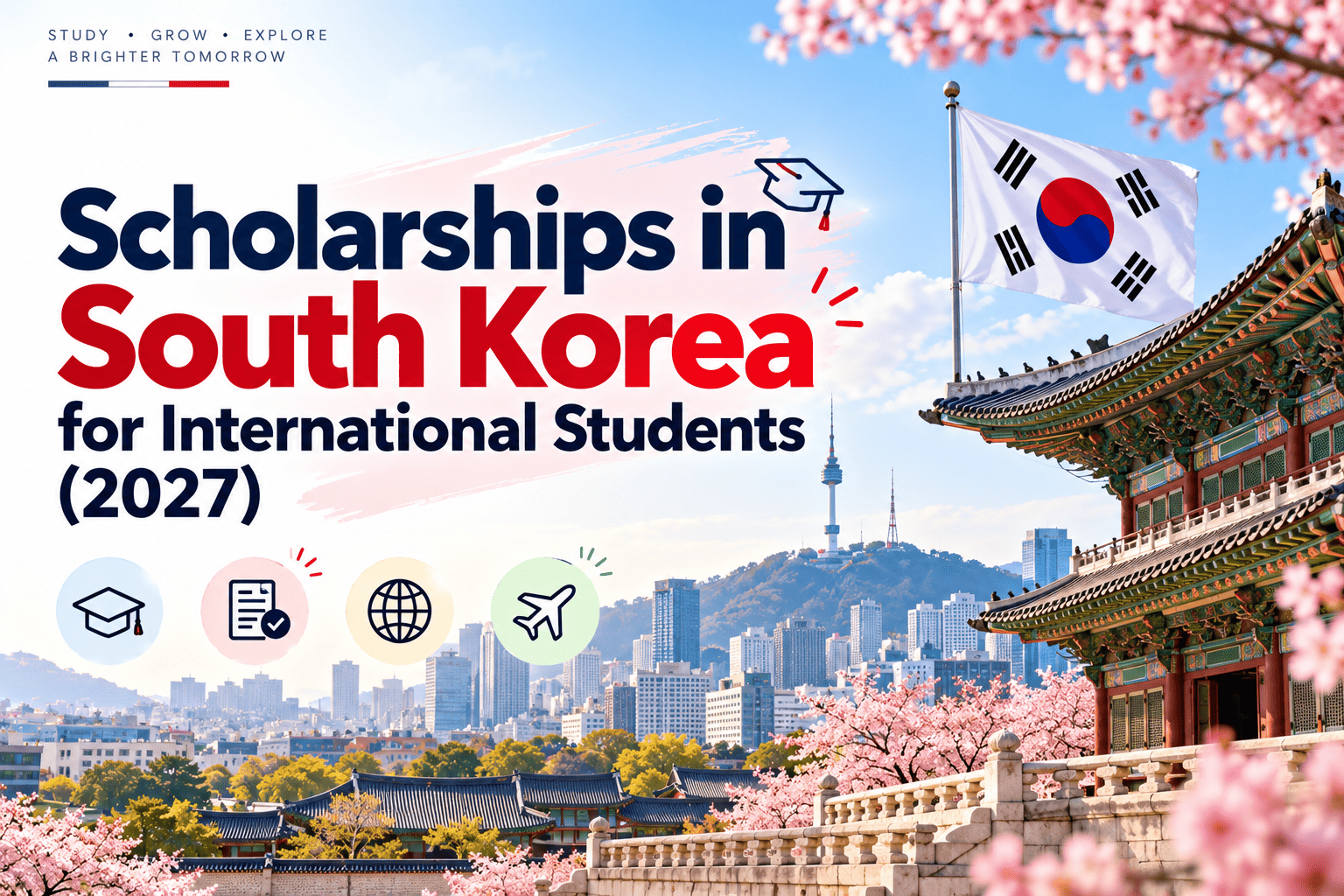
South Korea has exactly one giant, fully funded door for international students — the Global Korea Scholarship (GKS) — and a whole corridor of smaller doors around it: university winter schools, language terms and culture camps that let you test-drive life in Seoul before committing to a degree. This page covers all of them, because students ask us about both: the dreamers aiming at a fully funded degree, and the realists who want two or three weeks on a Korean campus first.
So here is the honest shape of it. The GKS pays for everything — tuition, airfare, a living stipend, health insurance and research funding — for undergraduate and graduate degrees at designated Korean universities. The winter programmes below are different: they are fee-paying, and we label them that way on every line. What they offer instead is speed and certainty — applications reviewed in weeks, English-taught courses, dorm beds and cultural programmes, at universities like Yonsei, Sungkyunkwan and Hanyang. Read the GKS section first if you want a degree. Read the winter list if you want Korea this December.
The flagship: Global Korea Scholarship (GKS)
Global Korea Scholarship (GKS) — Government of the Republic of Korea
Deadline: varies by embassy and university track — see the D2D post · Fully funded undergraduate & graduate degrees · View on Dare To Dream
The GKS is South Korea's flagship government scholarship, supporting international students pursuing undergraduate or graduate degrees at designated Korean universities — the eligible list runs to dozens of institutions, including Seoul National University, Yonsei, Korea University, KAIST and POSTECH. The award covers tuition fees, airplane tickets, a living stipend, health insurance and research funding. There are two ways in: the Embassy Track, applying through the Korean embassy in your country, and the University Track, applying directly to one university — each embassy and university sets its own dates and process, which is why the D2D post says "see official details" instead of printing a single deadline. The academic bar is stated plainly: a GPA of 80% or higher, or the top 20% of your class, and applicants must be under 40 (current professors from ODA-recipient countries, under 45). One detail worth checking early: of the 146 eligible countries, only 62 are eligible for the University Track — confirm your country's tracks on the official list before choosing your route.
University winter schools and short programmes (fee-paying)
Listed by deadline, soonest first. Every programme in this section charges fees — none of these is a scholarship.
1. Kyung Hee University Korean Language Program — Winter Term
Deadline: October 30, 2026 · Tuition-paying language programme (~₩1,600,000 per term, to be confirmed) · View on Dare To Dream
For students whose goal is the language itself: Kyung Hee's Institute of International Education runs a 10-week intensive Korean term (December 14, 2026 – February 24, 2027, about 200 hours of study) with dormitory housing available in Seoul. It's open to high-school graduates and above. The practical homework is real: a TB test taken within the last 2 months, measles vaccination proof, and — if you're enrolling for two or more terms and need the D-4 visa — a bank statement of ₩10,000,000 or more. Confirm the final tuition on the official IIE site before paying, as the D2D post flags the figure as indicative.
2. Korean Language & K-Culture Winter Camp
Deadline: November 10, 2026 (closes early when full) · Fee-paying short programme · View on Dare To Dream
The lightest-weight option on this page: a winter camp in Seoul built around Korean lessons, practical role-play, TOPIK-oriented learning and heritage excursions to Gyeongju and Andong. Accommodation, three meals a day, airport transfers, local transport and travel insurance are included in the package — international airfare is not. There's no credit chase here; this is for students who want a first, affordable experience of Korea and the language, and it fills up, so the November 10 date is a backstop, not a target.
3. Winter Abroad at Yonsei (WAY) — Yonsei University
Deadline: November 12, 2026 (16:00 KST) · Fee-paying winter programme · View on Dare To Dream
Three weeks (December 22, 2026 – January 8, 2027) at one of Korea's most famous universities: English-taught courses, a bed in the on-campus SK Global House / International House dormitory, and cultural activities across Seoul. It's open to university students at undergraduate level, and applications go through Yonsei's own portal (winterapply.yonsei.ac.kr). The early-bird deadline (October 20) has passed, so the general deadline above is the one that matters — and Yonsei states it to the hour, so don't plan a last-evening submission.
4. Hanyang ERICA Winter School — Hanyang University
Deadline: November 30, 2026 · Fee-paying — KRW 1,700,000 partner rate, including tuition, housing and 2 activities · View on Dare To Dream
A two-week winter school (January 17–31, 2027) at Hanyang's ERICA campus in Ansan, with all courses in English and up to 4 academic credits — a 3-credit course plus a 1-credit supplementary course. The fee bundles tuition, on-campus housing and activities including a ski experience and an Everland trip, and no home-university nomination is needed. One date worth money: apply by October 31, 2026 and complete payment by November 6 (KST) and you save ₩100,000 on the early-bird discount.
5. SKKU WISE — Sungkyunkwan University, Seoul
Deadline: December 13, 2026 · Fee-paying — tuition KRW 1,760,000 (one course) or KRW 3,080,000 (two courses), plus KRW 100,000 registration · View on Dare To Dream
SKKU's Winter International Student Experience runs December 22, 2026 – January 7, 2027: credit-bearing courses in English across Business & Economics, Social Sciences & Humanities, Computer & Data Science and Korean Studies, plus a ski trip, K-pop dance classes and a Lotte World visit. It's open to undergraduate, Master's and doctoral students from overseas universities with a GPA of at least 2.0; the optional dorm costs ₩690,000, and students taking two courses can add a research internship. Discounts are genuine and stackable in some cases — 30% early bird for applying by October 31, 2026, 30% group discount for 3+ students from one university, 40% for alumni — so check which applies to you before paying full price.
6. Seoul International Winter School (SIWS) — University of Seoul
Deadline: January 8, 2027 · Fee-paying — KRW 1,700,000 (partner universities) to KRW 2,200,000 (general rate) · View on Dare To Dream
The latest-closing winter option: two weeks in Seoul (February 9–22, 2027, with an online orientation on February 1) combining Korean language classes with Korean Studies lectures in English — K-pop, K-drama, Korean food and heritage — plus field trips and a Certificate of Completion. You must be an enrolled undergraduate or graduate student at an overseas university with a passport valid at least 6 months from entry, and no home-university nomination is required. Pricing rewards the organised: non-partner students who complete registration and the full application by December 1, 2026 pay the ₩1,900,000 early-bird rate instead of ₩2,200,000.
Also watch: university scholarships beyond GKS
The GKS isn't the only funded route into a Korean degree — top universities run their own awards, and KAIST is the clearest example, verified from KAIST's official admissions materials. KAIST offers its KAIST Scholarship to every admitted international undergraduate: full tuition exemption for 8 semesters, a living allowance of ₩350,000 per month, and medical health insurance — you simply select "KAIST Scholarship" as your funding source inside the admission application; there is no separate scholarship form. At graduate level, the KAIST scholarship package likewise covers full tuition (4 semesters for a Master's, 8 for a PhD) plus a monthly stipend. If your heart is set on one Korean university for science and technology, applying to KAIST directly can be as strong a route as the GKS itself.
A note on how fast winter deadlines move
Chung-Ang University's International Winter Program — two weeks in Seoul focused on K-Entertainment and K-Contents — closed on October 27, 2026, the day this page was verified. That's the pattern every year: Korean winter schools open in September–October and quietly close while students are still "thinking about it." If a winter programme above fits you, treat its deadline as this week's job, not this season's.
How to apply for scholarships in South Korea
- Decide degree or taster first. A degree means the GKS (or a university's own scholarship, like KAIST's). A taster means a winter school — cheaper and faster, but fee-paying. The two paths share almost no paperwork.
- For GKS, choose your track early. Embassy Track and University Track have different dates, different document routes and different country eligibility (only 62 of 146 countries can use the University Track). Pick one and build backwards from its calendar.
- Prepare the GKS document set once. Application form, personal statement, study plan or research proposal, a recommendation letter, transcripts and citizenship proof for you and your parents — this set is heavier than most, so start it months ahead.
- For winter schools, watch the early-bird dates. Hanyang, SKKU and SIWS all discount early applicants by ₩100,000–30%. The cheapest application is an early one.
- Apply through official portals only. Every D2D post links the official programme page — Yonsei's winter portal, UOS's application system, the GKS official site. No agent can sell you a GKS seat.
Frequently asked questions
Is the Global Korea Scholarship really fully funded? Yes — it is a Korean government award covering tuition fees, airfare, a living stipend, health insurance and research funding for undergraduate and graduate study at designated universities. That's exactly why its academic bar is firm: GPA of 80% or higher (or top 20% of your class) and under 40 years old for most applicants.
Can I apply for GKS from Pakistan, India, Bangladesh or Nepal? The GKS is open to a wide list of eligible countries — 146 for the Embassy Track — but only 62 countries are eligible for the University Track, and the lists are published officially each cycle. Check your country's eligibility for each track on the official GKS site (linked from our D2D post) before you invest in the application.
Are the Korean winter schools scholarships? No — and anyone who tells you otherwise is selling something. Every winter programme in the list above charges fees (from about ₩1.6 million for a language term to ₩3 million-plus for two credit courses with dorm). What they give you is a short, structured, English-taught experience of a Korean university. The fully funded routes are the GKS and university scholarships like KAIST's.
Do I need Korean language skills or TOPIK? For the winter programmes, no — courses are taught in English, and several exist precisely to teach you Korean from zero. For GKS degrees, Korean is not required to apply (language proficiency scores in Korean or English earn additional points), and GKS scholars typically receive Korean language training as part of the award structure.
Keep exploring
- See every South Korea listing and more in the full Dare To Dream opportunities database.
- Comparing East Asia's big three? Read our guides to scholarships in China and scholarships in Japan.
- Planning the whole 2027 season? The GKS sits inside the deadline-ordered fully funded scholarships 2027 hub alongside every other major award.
Dare To Dream verifies every listing against official sources. Deadlines and fees above are copied from the individual scholarship pages — always confirm final details on the official programme page before applying.
Explore matching live records or continue planning in your D2D student account.
Explore opportunities →