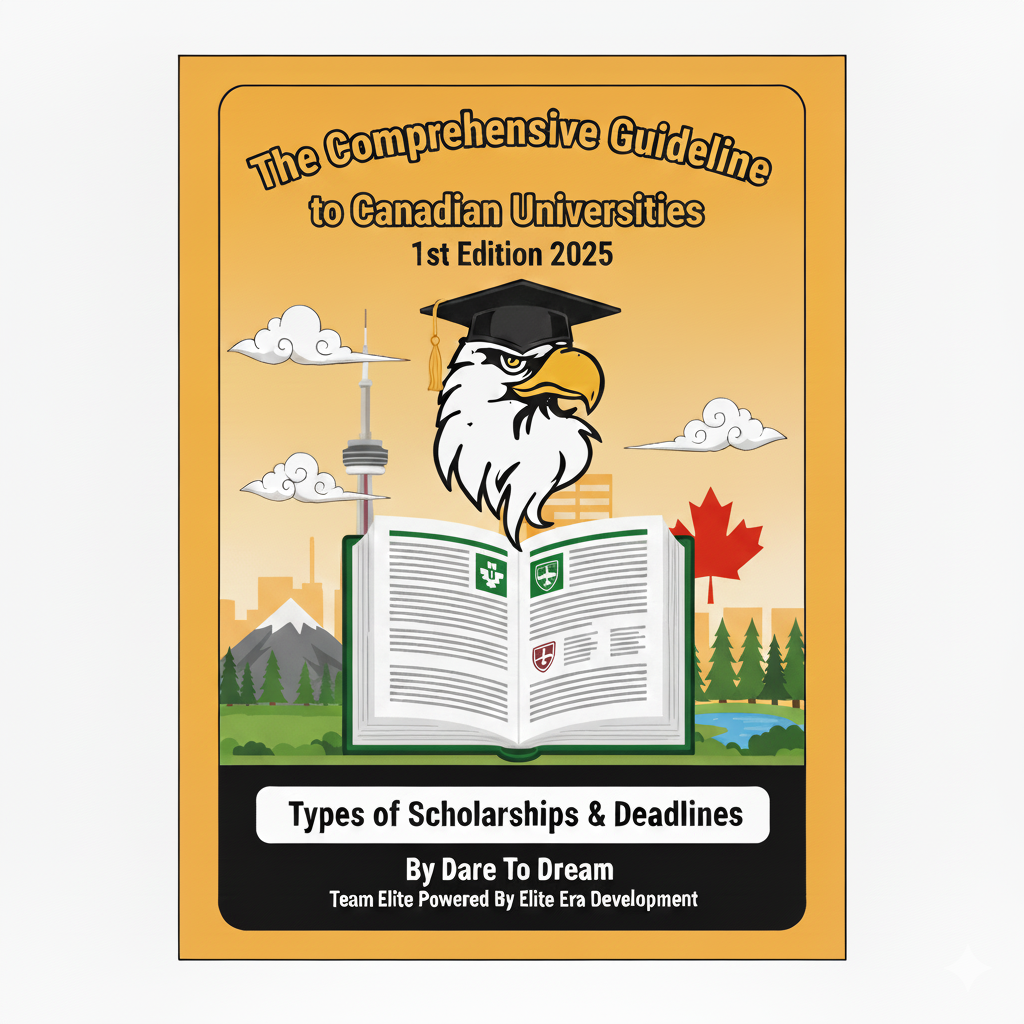
The Complete Guide to Studying at Canadian Universities in 2026 is your go-to e-book for planning higher education in Canada. It covers everything international students need from choosing universities to understanding admission requirements, scholarships, and visa steps. Canada offers top-ranked universities, diverse programs, and a welcoming environment for students worldwide. This guide helps you explore affordable options, application deadlines, and living costs. Whether you’re aiming for undergraduate, master’s, or PhD studies, this book provides expert tips to make your journey smooth and successful. Start your study abroad dream confidently with The Complete Guide to Studying at Canadian Universities in 2026.
Canada is one of the world’s top destinations for international students thanks to high-quality universities, generous scholarship programs, and post-study work opportunities. The Dare To Dream curates an up-to-date list of ongoing scholarships, bursaries and fellowships for study in Canada from university-specific awards (UBC, McGill, University of Toronto, etc.) to national programs and private grants.
Who can apply
International students (undergraduate, masters, PhD) many listings explicitly accept international applicants.
Domestic/Canadian students some awards are for Canadian citizens/residents only (check each scholarship).
Researchers / early career scholars some fellowships target doctoral or postdoctoral researchers.
Students from specific countries or regions a few programs target applicants from developing countries or specific partner nations.
Typical requirements (what scholarship pages usually ask for)
Common requirement
Why it's requested
Completed application form (online)
Basic screening & contact info
Academic transcripts / certificates
To verify GPA and program level
CV / Resume
To review academic and extracurricular background
Personal statement / motivation letter
To assess fit and objectives
Letters of recommendation
Academic/professional endorsement
Proof of English/French proficiency (IELTS/TOEFL)
For non-native speakers if required
Research proposal (for PhD)
To evaluate research fit and quality
Passport / ID and sometimes residency proof
Identity and eligibility verification
Note: exact requirements vary by scholarship and by university always check the specific scholarship page for the authoritative list.
Deadlines
Deadlines vary widely between awards and change year-to-year. The Dare To Dream Canada page lists each scholarship with an “APPLY NOW” link click the specific scholarship to see its current deadline. If you’re targeting a particular university (e.g., UBC, McGill, University of Toronto) check both the scholarship page and the university’s official site for application windows.
What these scholarships typically offer
Full or partial tuition fee coverage (some fully funded, others partial).
Stipends or living allowances (for some masters/PhD fellowships).
Accommodation support or bursaries for international entrants.
Research funding, travel grants, or professional development support (for doctoral/fellowship awards).
Additional benefits such as mentorship, internships, and access to university resources.
Quick sample table selected scholarships.
Scholarship
Level
What it offers (summary)
Deadline / Note
University of Toronto Mastercard Foundation Doctor of Public Health Scholarships (2026)
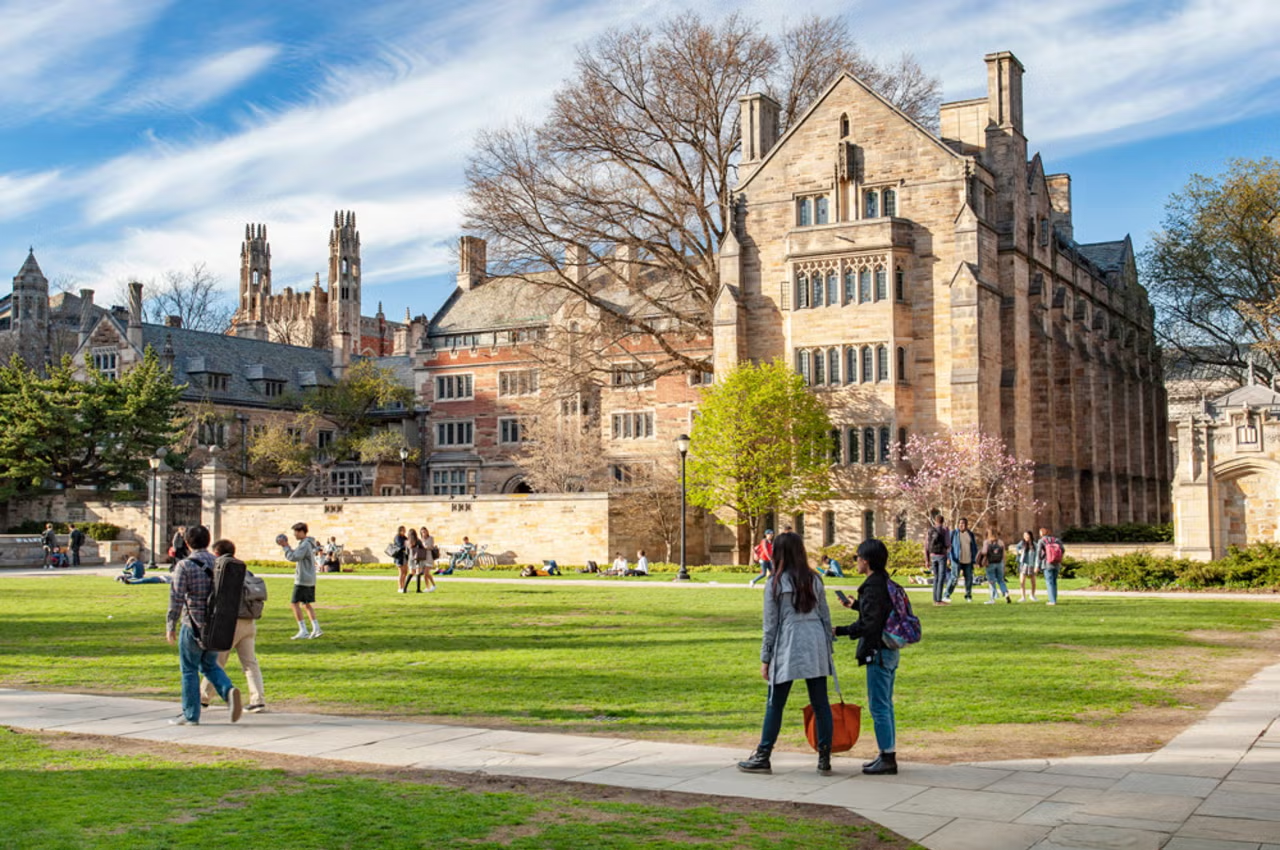
For students around the world dreaming of studying at Yale University, the good news is that Yale’s financial-aid policies make access far more than just a dream. At Yale, the focus is on need-based aid rather than merit scholarships alone. The guidance below gives you a breakdown of who can apply, what you need, deadlines, what’s offered, and a direct link to the official site.
Who can apply
Undergraduate applicants (U.S. citizens, permanent residents, and international students) are eligible for full need-based financial support at Yale.
Graduate/professional (masters/PhD) students: it varies by school/faculty many programmes at Yale offer fellowships or aid based on need or merit.
High-school level/pre-university: e.g., the Yale Young Global Scholars (YYGS) summer programme offers need-based scholarships for high school students.
Requirements
Requirement
Details
Admission to Yale
You must be admitted to Yale (undergraduate or graduate programme) before the full-aid policy kicks in.
Demonstrated financial need
For undergraduate students, Yale assesses family income, assets, size, and other factors.
Financial-aid application forms
For undergrads: CSS Profile (and FAFSA for U.S. citizens) by the deadlines.
For graduate/professional students
Check the specific school (e.g., Yale School of the Environment: need-based aid deadline Feb 1 for incoming students).
Submit on time
Missing deadlines can affect your aid package.
Note: Yale does not offer “merit-only” scholarships for undergraduates aid is awarded solely based on need.
Deadline
Category
Deadline
Undergraduate application (Early Action)
November 1 for Single-Choice Early Action.
Undergraduate application (Regular Decision)
January 2 for Regular Decision.
Financial-aid application forms
For best consideration: CSS Profile & FAFSA by November 1 (Early) / February 15 (Regular) for incoming undergraduates.
Graduate/professional programmes
Varies by school — e.g., YSE: Feb 1 for incoming students.
What it offers
For undergraduates: Yale commits to meeting 100% of demonstrated financial need for all admitted students (U.S. & international) — not based on merit.
Families earning under a certain threshold (for example <$75,000) may pay little to nothing for tuition, housing and meals.
No merit scholarships for undergraduates the aid is structured as grants (not loans) for eligible students.
For graduate/professional level: many programmes provide fellowships or scholarships, but conditions vary by school, department, and student’s country of origin.
Additional good things: access to Yale’s resources, global network, top-tier faculty and facilities.
Bachelor's & Master's Scholarships in Finland 2026
PriceFREE
About This Book
Thinking about studying in Finland? Many Finnish universities and universities of applied sciences (UAS) offer scholarships or tuition-fee waivers for non-EU/EEA students applying to Bachelor’s and Master’s programmes. These scholarships vary by institution and programme, so it’s important to check the specific programme page when you apply.
Who can apply?
International applicants from outside the EU/EEA who are applying for Bachelor’s or Master’s degree programmes in Finland.
Eligibility (and whether a scholarship is available) depends on the specific university and programme some programmes automatically consider scholarship candidates during admissions, others require a separate scholarship application.
Requirements
Requirements differ by university, but commonly include:
Admission application to the target Bachelor’s or Master’s programme (often scholarships are applied for at the same time).
Proof of previous education (secondary school diploma for Bachelor’s; Bachelor’s degree for Master’s).
Language test / language requirements (English or Finnish/Swedish depending on programme).
Motivation letter, CV, references, portfolio or entrance test depending on the programme and scholarship type.
Some scholarships are merit-based (academic excellence), others may be targeted (e.g., programme-specific). Always check the exact instructions provided by the university.
Deadline
There is no single deadline for Finland-wide scholarships deadlines follow each university’s admission schedule.
Typical flow: you apply for admission during the application round for the programme; scholarship information (and the deadline to request/apply for it) is usually published together with the programme’s application instructions. Always check the university’s programme page and the Studyinfo.fi listing for exact dates.
What the scholarships offer
Most scholarships and tuition waivers help cover tuition fees (full or partial).
Important: Scholarships usually do not cover living costs, travel, or visa fees. Students are generally expected to fund their own living expenses in Finland. Beware of social posts claiming “fully funded Finland government scholarships” that cover all costs those are often misleading.
How to check & apply step-by-step
Pick a programme you want to study (search on the university site or Studyinfo.fi).
Read the programme’s application instructions look for scholarship/tuition waiver sections.
Submit your admission application (many scholarships are applied for during admission).
Follow the university’s scholarship application steps if a separate form or documents are required.
Prepare to cover living costs independently even if you receive a tuition scholarship.
Quick summary table
Topic
What to expect
Who offers
Finnish universities & universities of applied sciences (UAS).